
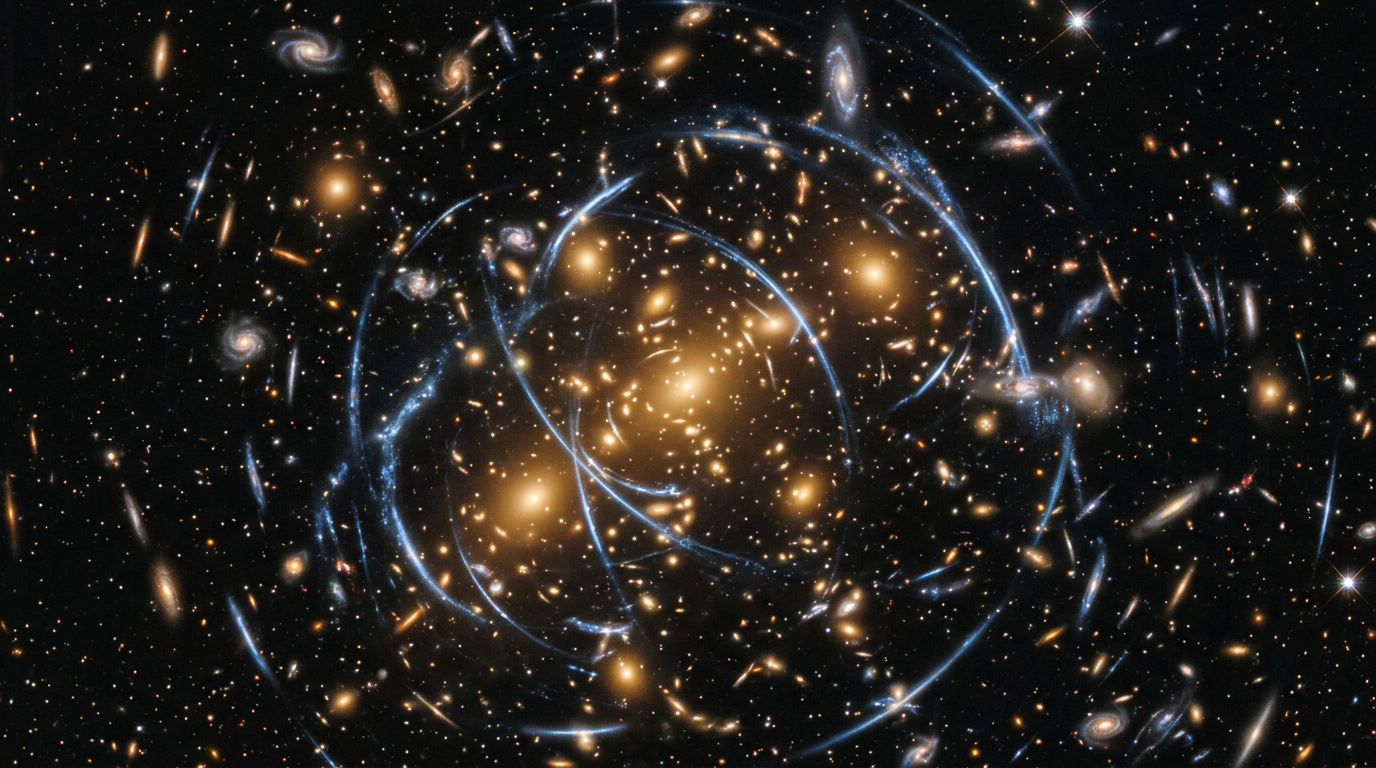
If a galaxy cluster sits between us and a more distant galaxy, light bends the way a wine glass warps the edge of a table. That bending is gravitational lensing, and it is one of the cleanest tools astronomers have for weighing things they cannot see.
Einstein predicted this effect in general relativity, but early measurements were difficult. Today, space telescopes and large ground observatories provide images detailed enough to turn warped light into practical data.
The effect is small for everyday masses, but enormous for clusters of galaxies. The stretched arcs and duplicated images in deep-sky photographs are not quirks of the camera, they are signatures of mass, including dark matter, spread through the cluster.
Scientists usually work with two scales. Strong lensing produces dramatic arcs and multiple images, while weak lensing creates subtle distortions in many background galaxies that only emerge through statistical analysis.
Researchers compare lensed images with models of how mass should distort space. When the models match observed patterns, teams can estimate where unseen matter clusters and how concentrated those regions are.
This matters because ordinary matter alone cannot explain the shapes. X-ray maps show hot gas, optical telescopes show stars and galaxies, and lensing often reveals additional mass where little light is visible.
Multiple observations improve confidence. When lensing results align with measurements from galaxy motion and cosmic microwave background studies, astronomers gain a more coherent picture of large-scale structure.
There are still uncertainties. Instrument noise, foreground contamination, and assumptions inside models can shift estimates, so major studies publish ranges and test several independent reconstruction methods.
Even with those limits, lensing has become a central tool for cosmology. It helps researchers test how matter clumps over time and how fast cosmic expansion influences the growth of structure.
For non-specialists, the key point is simple: lensing lets science map invisible mass through its gravitational effects, not through guesswork. It turns a visual oddity into measurable evidence.
None of this turns dark matter into something you can hold. It does, however, convert a strange prediction into working maps, and those maps are how astronomy moves from theory toward clearer understanding.