
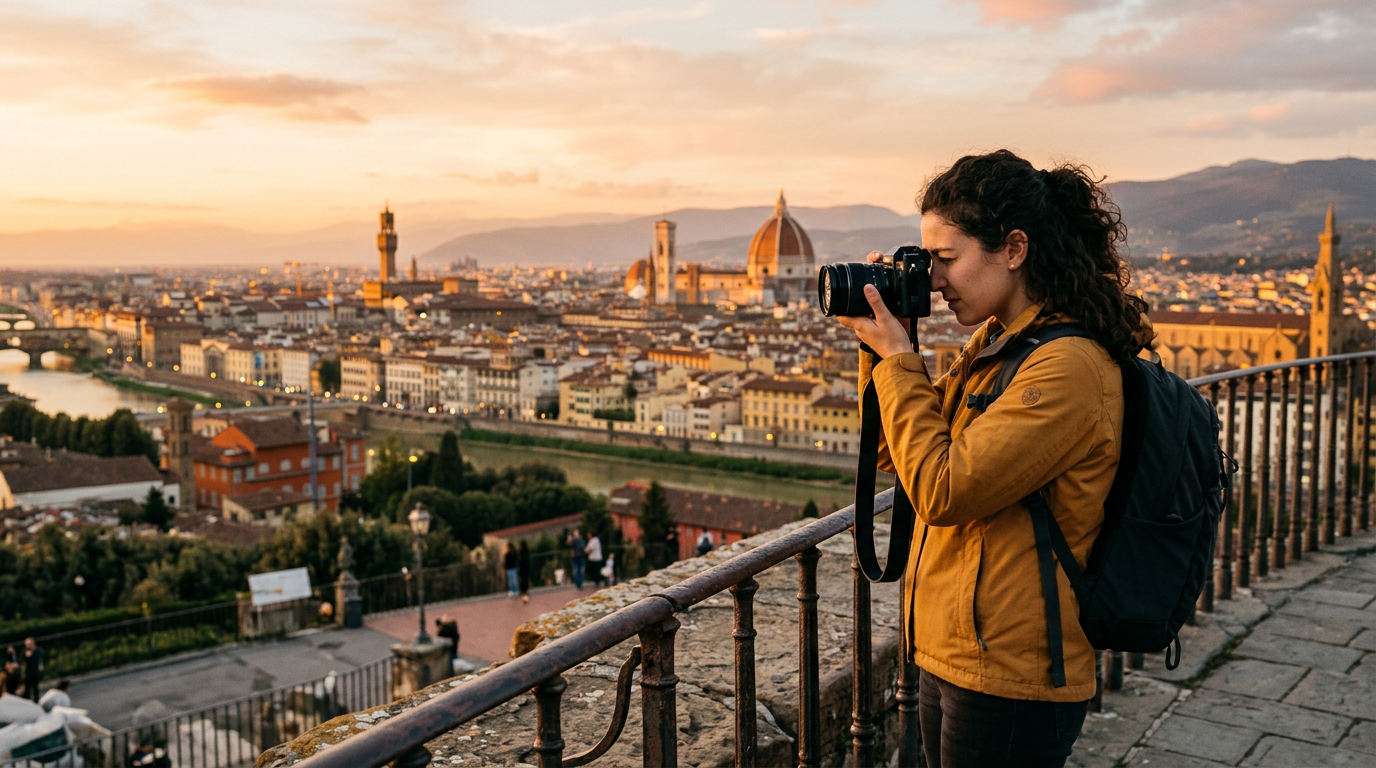
The postcard composition works for a reason, but repeating it often produces images that feel generic. A stronger approach starts by changing angle, height, or foreground elements.
Try stepping one or two streets away from the main viewpoint. Side perspectives often reveal texture and scale that disappear in front-on landmark shots.
Longer focal lengths can simplify cluttered scenes by compressing distance. This helps isolate architectural details without standing directly in crowded plazas.
Wide shots still have value when used intentionally. Include leading lines, shadows, or nearby activity to give context rather than capturing only the facade.
Weather is an advantage, not a limitation. Light rain adds reflections, while overcast skies reduce harsh contrast and preserve stone or facade detail.
Time of day changes emotional tone. Early mornings offer cleaner frames, while evening light can add depth and warmth to familiar structures.
Foreground storytelling improves landmark photos. A tram, cyclist, or market stall can make the place feel lived-in rather than detached from daily life.
If people appear in frame, compose respectfully. Silhouettes, motion blur, and wider spacing help protect privacy while preserving the sense of movement.
Stability matters for sharper low-light images. Use walls, railings, or gentle breath control when tripods are impractical in busy public spaces.
Take fewer but more deliberate frames. Pause to check edges, distracting signs, and horizon alignment before pressing the shutter repeatedly.
The goal is not to avoid famous views entirely. It is to make photos that reflect your own experience of the place, not only the version printed on postcards.